Monday, March 19, 2012

First signs of Spring

This has been a pretty mild Prairie winter. And the signs of Spring arrived much earlier than it did last year! Tomorrow is the official First day of Spring. Although some years, that is just a technicality and the temperature could be -20 with 2 feet of snow on the ground. This year, it appears almost spot on.
For a week or so now I have heard and seen the return of the Canada Geese, and even a few ducks. And yesterday, the gophers were out. (Richardson Ground Squirrel). I took a picture of this guy out in the field where the cows were bale grazing.

Another sign we start looking for, is the first real growth of grass. Last year I documented the first weeds at April 17th, and the grass didn't really start until April 20th. But today I saw grass. Grass that wasn't there yesterday. That is pretty exciting. Of course by this afternoon the rain had turned into sleet and by tonight it will be snowing. Spring is fickle and dances just beyond our reach!

So what are we busy with this time of year?
Well let's see:
  •  last week I vaccinated all the goats, and dewormed the ones that needed it. I also trimmed  their hooves as needed, and they are now ready for the kidding season that starts in 4 weeks. 
  • Next, I am working on getting set up for shearing day for the sheep, which is next week. On shearing day, the sheep will receive their vaccinations too.
  • Last year the snow came early, and my yard is still covered in leaves which I would like to tidy up. 
  • I have started some veggie and flower seedlings indoors in preparation for the gardening season.
  • What I like to do now is prepare lots of easy meals for Spring when I am busy with kidding, lambing, and chicks in the brooder as well as yard work and getting the garden ready, and my day job. So when I cook, I make extra large batches. Extra chili, beef stew, chicken soup, bean soup, butternut soup, cookies and granola bars are processed into meal-size portions and frozen, ready to just heat up after a long day. 
  • Then of course there is Spring cleaning, and checking supplies for kidding and lambing season: electrolytes, colostrum, milk replacer and nursing bottles in case they are required, vitamins, a stomach tube to quickly get colostrum in chilled goat kids, ear tags are ready to record births.
A busy time of year! Spring is about rebirth, awakening as the short days of winter give way to longer days, milder weather and the glorious anticipation of the return of Life.

Monday, March 5, 2012

The Guardian

I got a llama yesterday! This is Jewel, she is 10 years old and registered.

It was a bit foggy out this morning, which made for some neat pictures
Jewel with the sheep

Checking out the short fuzzies...

...And the tall majestic ones....

an itchy moment

Jewel seems very alert and curious. She has been handled lots and is halter broke, I still need to remove her halter. The sheep are familiar with llamas so they were not too traumatized. The goats think she's a bit weird but they don't really care. The milk cow - well maybe her eyes got a bit bigger, it's hard to tell, she is a Jersey with pretty big eyes as it is! :) 
The horses weren't really spooked but they thought it was a great excuse to ACT spooked and run around like crazy things! 

I caught Macy and Jack standing still in the fog:
Macy

Jack

The only ones that really noticed the llama, were my dogs. They know to stay out of the pens, but they run around the paddocks. They barked and growled at the strange new creature.

My hopefully future herding dog, Spice

I will monitor Jewel in the next week or so, to make sure she bonds with the flock. It might be a bit of a challenge because the goats come back to the corral to sleep at night, but the sheep prefer to sleep in the pasture. The horses go wherever they feel like it. If it looks like she is not bonding, I might separate the horses out into one camp, and bring the sheep up to the corral at night too.


Wednesday, February 29, 2012

Predators

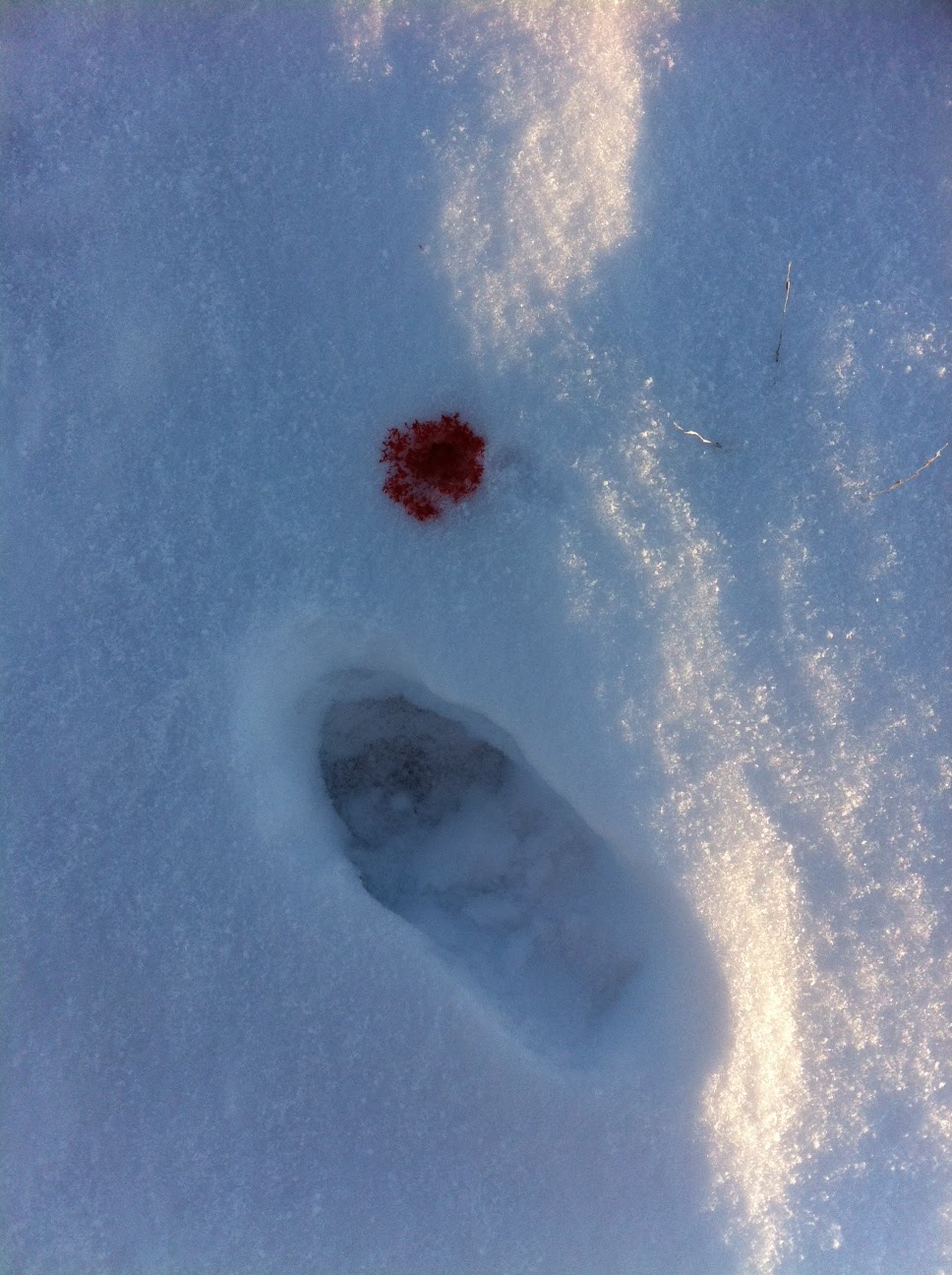
Well it finally happened. I have not seen any coyotes around the farm, although one can hear them. Every day, I walk through my animals and check for things out of place. I had been away for a few days to a Holistic Management conference, so at the earliest opportunity on my return, I took a walk. I check fences, look for sick animals, check feed, just... look around. and observe. Well I found a blood spot. Fresh.


My heart raced. I walked more carefully, scanning the ground for more signs. Quickly, I found another spot


And with that spot, a 2" piece of fleece. Soft. Short. LAMB. I knew that some of the sheep might be bred, due to a ram that got out. Rams and bucks and bulls, they always get out. So I was prepared for an early lamb or 2. I was not prepared for a predator that struck so quick and silent. The skin was soft, not frozen. This was an early morning kill. Was the lamb born dead? I don't know. I almost think not, due to the amount of blood I found. The herd didn't really seem too upset. I did a perimeter check and found tracks coming in, and going out of the mesh fence
What was it? A fox? a coyote? I am not sure, but I lean towards coyote. I followed the tracks. They wondered, this way and that. I found a few blood spots next to tracks, but no other evidence of a lamb. Nothing. There was a spot where my unwelcome diner had relieved itself. Eventually my trail ran through one of my camps again and I lost it - too many little hoof prints to distinguish the predator tracks.


The next day, we had a blizzard. Lots of snow covered up the tracks. A day after the blizzard I went to see what else I could find


Fresh tracks! And some scat in one of my pastures
I scanned the places where he had come into the paddocks. Did he jump? Or crawl through? Foxes can fit through some pretty small holes, they will fit through a mesh fence. Some predator specialists say that coyotes don't jump, preferring to crawl under. I found, at long last, a single hair, caught in the mesh, fairly high up. He must have jumped.
His tracks disappeared into the sunset.

But I know he will be back. And I will be ready. I hope to pick up a Llama later this week, and I have managed to obtain 2 adult Livestock Guardian dogs on a loan. I hope that they will serve me until I can get a pup and get the pup trained through the summer for next year.

I don't hate predators. They are only doing what they do best, what they evolved to do over millions of years. Through our meddling in Nature, we have created an abundance of prey. I can just imagine this guy standing outside my fence, staring in wonder at the goats and sheep, all so neatly contained by the fence. All so tempting and edible. But with my Llama and my dogs, I hope to convince him to go dine on rabbits, deer and gophers instead.

Friday, February 10, 2012

We have babies!

I am not advocating winter 'kidding'. I like to try and match my animals up to a more natural time for kidding, such as Spring when the deer are having babies. But the bucks had their own idea. Excitement got the better of them on August 31/11 and they broke out of their pen. One afternoon of frolicking and I have 7 healthy babies from 4 does. When the bucks went out at the appointed time at the end of November, they sported breeding harnesses with color markers, so that I would be able to record which does were covered when. And of course there were a few that, at the end of the 45 day breeding cycle, didn't have any crayon marking on them at all. So towards the middle of January, 2 weeks before these girls were due, I sorted them off and penned them where I could keep an eye on them. Thankfully the weather stayed remarkably mild, and January 25th we welcomed our first 'Pilgrims'. After a week in the pen with their moms, I turned them into a bigger pen
Little girl explores snow

La Mancha with her 2 babies. LaBoer :-)

A very nice little buckling

This is one of Mancha's daughters with her first kids

A nice little doeling explores the ground

These are the first kids from my registered bucks, Balmaur Vincente and Balmaur Sidney, or Bob and Joe as they are known around here. :-) 
If this is a sampling of what's to come in the Spring, I am very excited to meet the rest of their progeny.


Saturday, January 14, 2012

Bracing for the cold

Seeing as I live in Saskatchewan, I know that the cold will come, eventually. So far we have been blessed with an unseasonably mild winter. Warmer weather is easier on the animals, no one enjoys -20 weather with wind. But the weather forecast is calling for a change this coming week. -15 to -20 daytime and deep in the -20's at night, with wind chills of -30. BRRRR.

So today we will put out feed for the herd for the coming week. Normally we roll out 4 bales and that lasts 5 days for the 70 goats, 52 sheep, 4 horses and the milk cow. But we will add an extra bale this time, because in really cold conditions the animals can consume up to 20% more.
Ruminants are amazing creatures. Their rumen acts as a giant fermentation vat, and the fermentation generates heat. Instead of feeding grains, we feed more hay. With a warm belly and a spot to hunker down out of the wind, these amazingly hardy creatures do just fine.
It is our empathy that can get us into trouble. Lots of folks will say its too cold! bring them into a barn!  The trouble with a barn being that you need good air circulation, or ammonia builds up and that is more damaging to their lungs than fresh, cold air.
There is no barn for deer in nature, they simply know to find a spot out of the wind and wait out the storm.
A barn is a fine thing if one only had say, 2 milk goats and a horse. But everything that is carried in (feed, bedding) needs to be carried out. Feeding 120 small ruminants and the horses and cow inside a barn, would create an enormous pile of bedding and manure. Then one would need a structure that can be cleaned with the use of a skidsteer - to remove the bedding and manure, and spread it on the land where it will fertilize the grass. But lots of the nutrients are lost this way, whereas if the animals are out on the land, they deposit their own fertilizer all over, no need to rent a skidsteer!

Of course, one needs the right kind of animals for ones management style. My goats are acclimatized to being outside. The sheep are range sheep. One could not take a dairy goat that has been living in a barn all its life and kick it out. Careful selection will create a healthy, hardy herd.

I am hoping for some snow with the cold weather. Snow has some insulating value, and adds easily accessible moisture - the animals have a choice to eat snow where they are, instead of walking to water.

And as I bundle up my practically hairless hide to go outside, I marvel at Nature creating fleece to keep the sheep warm.

Thursday, January 12, 2012

Exciting times!

A New Year, new possibilities!
I love my life! So much to learn, every day. I always knew that I wanted to farm, somehow, somewhere. Now it is becoming a reality. In 2011 I expanded my goat herd to 70. I got 50 sheep. I look forward to this years kidding and lambing season!
A few images from the past year:
A Year of Storms: 
We had some pretty scary looking clouds, rain, wind, hail, and floods.


 Flood water


Chickens
Can you spot the goat in the photo below?
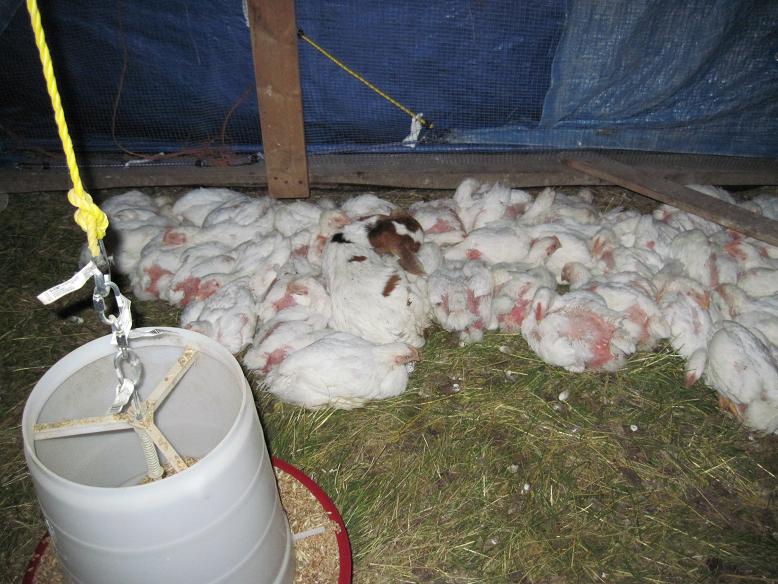
One of my last orphans curled up with the chickens one chilly evening
 Chickens enjoying space, sunshine, shade, grass. 
We try to raise our animals as ethically, naturally and sustainably as possible.


Custom cows
my boyfriend grazed some 220 custom cattle this summer


Garden
 My square foot garden in my back yard, with my chicken coop visible


 Sheep and goats


 Winter Wonder


Saturday, December 10, 2011

The dilemma of buying eggs

I have a small flock of heritage chickens, about 16 hens. Chantecler (the only Canadian breed of chicken) and Buckeye. They are cold-tolerant (no combs to freeze on these chickens) and very friendly. I built them an insulated coop with 2 large South facing windows for lots of natural daylight. Normally they are out from dawn till dusk, foraging. Even in winter I will leave the pop door open on most days, and some of them will venture out (as long as I shovel the snow away from the coop) and sit in the sun or wander around.
Well, these hens give me a glorious abundance of eggs in summer - usually a dozen a day. The yolks are dark yellow, almost orange. We feast on eggs in summer! Omelets, scrambled, fried, boiled. I pickle bottles full that disappear just as fast as I can make them! I sell some and give some away to family.
But Fall arrived and my hens started molting. And stopped laying. One by one, until I was getting an egg a day. Now - nothing. And its Christmas baking season, I need eggs!
So off to the store I venture. Hmmm. The cheapest eggs are $2.81 per dozen. Doesnt say anything about free run or free range. There are some Organic Free Range eggs for $5.89 per dozen, and some Free Run eggs for $5.79.
In principle, buying cage raised eggs for $2.81 a dozen just seems.... wrong. If you have ever been to an egg farm (and I have) and seen 5 hens per cage that is about 2ftx2ft, with wire floor, stacked 5 high in a barn with about 2,000 birds..... no sunlight, no green grass, no dirt to scratch in. No quality of life. These hens are pale, their eggs are pale. They have a conveyer bringing them food 24/7, and a conveyer collecting the eggs that roll out of the slanted floor 24/7. Oh, my heart breaks for them. Sure, they know no different, but is that a good reason to treat them the way we do?

I have full empathy for city dwellers who cannot have a backyard hen or 3, and that want to eat ethically produced, natural food. And all that on a budget. How do you justify buying $5.89 eggs when you can buy $2.81 eggs?

So what did I end up buying? The $5.89 organic free range eggs. I gave my support to what I believe in.