Showing posts with label Nature. Show all posts

Thursday, April 11, 2013

SSS + S = sheep shearing stress + snow :)

Well it certainly has been a challenging winter, and there appears to be no end in sight!
Every week the weather forecast teases us with a double-digit forecast for the next week... but next week comes and goes, and the warmer weather remains elusive. Everyone is grumbling about the groundhog that was certainly mistaken, and my vet suggests the groundhog heard about the death threats and is currently sitting on a beach in Mexico..... lol

Seriously though, our grass in this region starts growing around April 17. My back yard still has 2 feet of snow, and the drifts at the farm are way higher than that. I moved my sheep shearing date up to April 18 from April 1, thinking for SURE the snow would be gone by then.... well.... probably not. More snow in the forecast for this weekend, and cooler temperatures again.

Last year I moved the sheep into the old shop the day before shearing, and we set up the handling alley in there for shearing. They need to be inside the evening before in case it rains (or snows!) to keep them dry. Preferably dry for 24 hours before shearing. Well, the shop still has 4 foot snowdrifts in front of it, and it would not be possible to use it. Unless we spend a day on the tractor to clear it out.

Option 2 would be to use the barn. That has its own challenges. Due to the record number of stormy days and more animals, the barn litter has accumulated dramatically through the winter. I keep adding more bedding and now the 8 foot wall is down to 5'6'' in places... meaning I bump my head on the rafters. The plan is to get a bobcat in the summer to clean the barn, but that is not possible to do now because there is nowhere to put the manure. Hmmm.

Option 3 involves using our stock trailer and rent a couple other trailers, and trailer the sheep down to Larry's farm to shear them in the double car garage or in the quonset. The quonset is full of stuff that will need to be moved, and half my sheep panels are still froze down so making a decent pen and alleyway will not be easy.

I cannot delay shearing much longer. Lambing commences May 1, there are always a few that pop up a couple days before that.
I went through my images from last year - a totally different weather picture!

This was taken March 25, 2012. the snow had gone,
the flood was up and the geese were happy

Shearing day March 27, 2012


April 6, 2012. A little dusting of snow. Notice the corrals in the back - no snow.
Right now (April 11, 2013) there are still 8 foot drifts in the corral, and foot deep snow in most places in the pasture. 


This was April 13, 2012. Where the chickens were in 2011. 
The grass started greening up

First kids were born April 18, 2012. 

My backyard, today. Those are my knee high Muck boots - the snow is up to my knees
April 11, 2013

What the barn looks like now. Notice 8ft drifts to the left in the corrals. 


Sunday, April 7, 2013

Journey to self sufficiency part 1

I'm passionate about self sufficiency and sustainability and being a good steward of the land. My little urban homestead is a work in progress, self sufficiency is a journey and it is certainly not completed in one day!

This list is for my urban homestead. I have a somewhat different view for the little farm where the sheep, goats, horses and other chickens are. More on that in a different post!


The yard September 2009


Early 2010 after a big rain. I had just had some landscaping done and the manure worked into the ground with a tiller. Probably end May?


2010 late May. Still having landscaping issues.


2010 July. The weeds grew prolifically in the new manure enriched soil! 


My square foot garden in 2011. Chicken coop in background


Garden beds changed in 2012 to save space and produce more.


Lawn with micro-clover in (nitrogen fixing) and garden in background, 2012.
The lawn looks bigger than it is. The yard was landscaped in 2009, and again in 2010 and 2011 to fix drainage issues. I also imported several truckloads of rotted manure and spread it in the yard... with a shovel and a rake. :) The ground was bare during landscaping, and this lawn was seeded April 2012, and the picture is early August 2012. Amazing transformation.


A book that inspired me greatly, I still read from it regularly. 
John Seymour wrote about rotational grazing and environmental factors long before others.
The first edition of this book was published in 1976. 


Things I do already:

  • I'm working on creating a permaculture yard with indigenous plant species.
  • A large raised bed vegetable garden with closely spaced plants( think square inch!) and poly culture plantings: planting basil in the shade of tomatoes or radishes with carrots.
  • The chicken coop is in the fruit orchard. The girls provide me with eggs and manure for the garden. They get rotated to fresh grass and get spoils from the garden.
  • I recycle everything I can.
  • I compost everything I can.


Things I would like to do:

  • When my current washing machine quits, I will replace it with an energy free model.
  • When my current dryer quits, I will not buy another one. A clothesline will do.
  • If my kitchen appliances quit, I will replace them with energy free models where possible - hand crank blender, etc.
  • I would like a wood stove for saving on energy bill - in fact I would like a Rocket Stove, which is more fuel efficient than a woodstove. But that might void fire insurance on my house....


Waste:

  • Recycle everything possible.
  • Compost everything possible
  • Re-purpose where possible: re-use egg cartons, re-use tin cans for starting seeds, buy wisely. Buy in bulk to minimize waste and packaging.


Water:

  • I plan to convert my toilet to a composting toilet and use the septic tank for grey water catchment only. That water can be used in the garden. I have a dirt basement so it should be fairly easy. Envirolet Composting has an extensive list of different styles, but I will have to save up some money for that as they are fairly pricey. 
  • Have a rain barrel to catch runoff from the eaves. Maybe even one for next to the chicken coop!
  • One side of my house eaves drain into the well in the front yard. 


Energy:

  • Improve home insulation and ensure doors and windows seal. Use passive heating/cooling by opening curtains on sunny winter morning, closing them to block out heat in summer.
  • I would like to install solar panels and a solar water heater. But good solar panels are still pricey. The provincial government in Ontario has some great programs for solar and wind, but here in Saskatchewan I will have to wait and see what programs they offer in the future.
  • Use space heaters to just warm the rooms you use most, when you use them.
  • When my current washing machine quits, I will replace it with an energy free model.
  • When my current dryer quits, I will not buy another one. A clothesline will do.
  • If my kitchen appliances quit, I will replace them with energy free models where possible - hand crank blender, etc.
  • I would like a wood stove for saving on energy bill - in fact I would like a Rocket Stove, which is more fuel efficient than a woodstove. But that might void fire insurance on my house....

Environment:

  • As many native plant species as possible.
  • Nesting for native bird life.
  • Shelter and food for beneficial insects and birds


Tuesday, July 10, 2012

Chickens part 1: layers

I haven't posted an update about our pasture poultry yet!
In part 1, I will talk about our laying hens.

Interested in adding some laying hens to our operation, I started doing some research and decided to order a red sussex cross type layer this Spring. These birds won't be ready to lay eggs until September, so in the meantime, Larry saw an ad for retired battery hens.
These poor gals weren't old, like a year and a bit. They were used to being jammed in a cage most of their life, 4 or 5 of them in a tiny little cage with wire sides, bottoms and tops. Artificial light regulates their daytime so maximize production. They never see daylight or feel grass under their feet, or have enough room to stretch their wings.

We brought them home in April and set them in a temporary old wooden bin so they could acclimatize before turning them out on grass. Their nails were long, their combs pale. They LOVED the bit of sunlight that came in through the wire mesh doors, and the shavings we put down for them to scratch in, and that there was room to run around and stretch their wings! Quite a few died the first week, they didn't know what to make of their freedom and piled into corners at night.
Enjoying some sunlight:
What they looked like straight from the cages - and believe me, those are 2 of the better looking ones...!


An egg comparison with my own layers, and the Leghorns before they started eating grass:
Pastured egg on left, 'cage' egg on right:


Chicken manure is exellent fertilizer - this was taken in early Spring: 

Can you tell the strip where the portable coop was? The green strip in the middle of the photo 

Finally it warmed up enough that we could put the hens outside. This was their first day out:

I am happy to report that they adjusted well, enjoy eating grass and chasing bugs and taking dust baths. Their combs look redder, their toenails have worn down from running around, their legs are darker color, and so are their eggs! 

Remember, everytime you  buy something, you vote - with your money. You are saying, I endorse this product by paying for it. Don't pay for battery hen eggs. Buy free run or better yet, pastured eggs from a farmer that you know and trust. 


Saturday, June 23, 2012

Grazing rotations

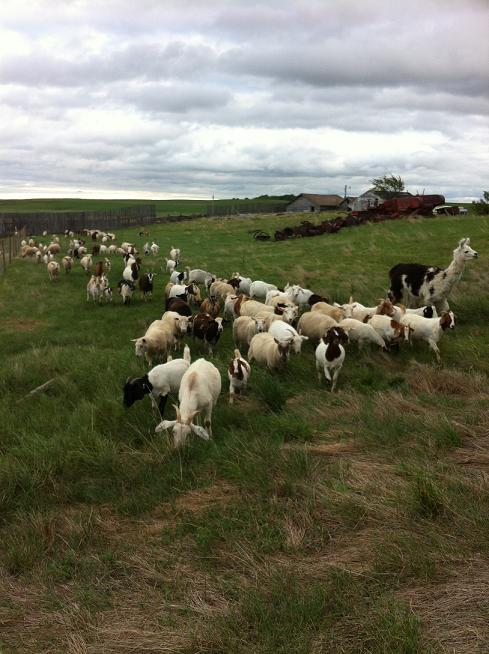
By dividing your pasture into smaller pastures and rotating through them, you can improve the quality and quantity of grazing available, if done right.

Before the age of Man and Agriculture and fences, wild animals roamed. The herds stayed in tight groups because of potential predators, and they were always on the move, looking for fresh grass. By mimicking nature and putting our animals in a tight group and moving them, we provide several benefits:
1. The grass has time to recover. Animals love fresh re-growth. They will eat the fresh stuff before the stale stuff. Right now our days are long, and grass can grow just about half inch a day, sometimes more. By moving our animals regularly, we avoid grazing the same plant again, while it is recovering from the first graze.
2. We avoid potential parasite problems - especially with the sheep and goats. For parasites to survive they need to hatch out on grass and be consumed by the host species. By keeping our animals moving, we leave the parasites behind, reducing infestation.
3. by grazing a tight herd, whatever doesn't get eaten, gets trampled into the ground. The trampled grass decomposes and feeds the microbes in the soil, providing organic matter for healthier soil. Healthy soil can grow more grass. The trampled stuff also acts like a mulch, keeping moisture in.
4. moving to fresh ground is instinctual, and the animals love it.
5. Its fun! :)

There are more in-depth benefits, but basically we want our pasture to be fully recovered before it is grazed again.

I use Gallagher Smartfence system to divide pastures. Right now I am grazing an area that lacks a permanent perimeter fence. The Smartfence is electrified, and once the animals learn to respect it, it works really well.

Can you tell where the electric fence was? 
Because this area hasn't been grazed in many years, I used a really small paddock and let the animals take most of the grass (not leaving much litter) to stimulate the grass to grow. Although it looks bare, it was only grazed for a day, so no overgrazing. It is also now littered with goat and horse droppings and urine, which is excellent fertilizer.

Another example, grass was grazed for a day on the right.

This is a picture of a paddock that was grazed and is recovering. 
You can still see the line down the middle where the fence was. 

animals enjoying fresh grass

Coming out through an alley to fresh grass.

The Smartfence. There is cropland to the left of the fence, and the goats are cleaning up a stony hill where I want to put up a perimeter fence. It's easier to fence if the grass is short and you can see potential obstacles!


A peaceful early evening graze.


Wednesday, June 13, 2012

Of Fauns and Things

I am very fortunate to live where I live. There is a big slough next to my pasture, inhabited by lots of ducks and water birds. I love listening to them in the early evening. The deer wander through our little town, and I was lucky enough to snap a photo of this little faun right next to railway avenue.

I have loads of birds in my yard thanks to all the trees, and I plan to build lots of different style nest boxes for them, as well as a bat house for the bats. Occasional skunk or raccoon travel through.
The first new growth of Spring excites me, as does the turning of the leaves in the Fall and the first flake of snow come Winter.

But there are so many people living in cities that never get to experience this, or feel connected to Nature. I believe this is what is getting our human race into such big trouble. We have forgotten we are PART of nature, that we are all part of the Whole. Nature isn't something 'out there'. It is within us, we ARE nature. Once the entire human race get that paradigm, there will be a collective shift away from our current direction of 'growth'. We will understand what we are doing is harmful.

But how do you get people to connect with nature? How to make them FEEL this planet that sustains them, and really, really appreciate it for the absolute marvel and wonder it is? How do we create awareness?

We are currently part of a help exchange program, called Helpx. Farms advertise who and what they are, and what kind of work they need help with. Volunteer helpers from all around the world then decide if they would like to come visit your farm. In exchange for room and board, they work 5 hours a day, 5 days a week. Or something along that line. We enjoy sharing our knowledge (or lack of it sometimes!) with international visitors. We talk about Holistic Management, show them the grass and its great when you see that 'a-ha!' moment, when  they connect. We would like to expand on that, and have more room to host more people. A communal dining hall and kitchen, a nice outdoor seating area with fire pit for evening conversations. If every person we awaken, could touch someone else, and so on, the awareness will grow.

Right now I am so busy with my own things, but I would love to encourage roof top gardening in city centers, community gardens and food awareness.
If anyone wanted to come and visit and see what we are about, they are more than welcome.


Saturday, January 14, 2012

Bracing for the cold

Seeing as I live in Saskatchewan, I know that the cold will come, eventually. So far we have been blessed with an unseasonably mild winter. Warmer weather is easier on the animals, no one enjoys -20 weather with wind. But the weather forecast is calling for a change this coming week. -15 to -20 daytime and deep in the -20's at night, with wind chills of -30. BRRRR.

So today we will put out feed for the herd for the coming week. Normally we roll out 4 bales and that lasts 5 days for the 70 goats, 52 sheep, 4 horses and the milk cow. But we will add an extra bale this time, because in really cold conditions the animals can consume up to 20% more.
Ruminants are amazing creatures. Their rumen acts as a giant fermentation vat, and the fermentation generates heat. Instead of feeding grains, we feed more hay. With a warm belly and a spot to hunker down out of the wind, these amazingly hardy creatures do just fine.
It is our empathy that can get us into trouble. Lots of folks will say its too cold! bring them into a barn!  The trouble with a barn being that you need good air circulation, or ammonia builds up and that is more damaging to their lungs than fresh, cold air.
There is no barn for deer in nature, they simply know to find a spot out of the wind and wait out the storm.
A barn is a fine thing if one only had say, 2 milk goats and a horse. But everything that is carried in (feed, bedding) needs to be carried out. Feeding 120 small ruminants and the horses and cow inside a barn, would create an enormous pile of bedding and manure. Then one would need a structure that can be cleaned with the use of a skidsteer - to remove the bedding and manure, and spread it on the land where it will fertilize the grass. But lots of the nutrients are lost this way, whereas if the animals are out on the land, they deposit their own fertilizer all over, no need to rent a skidsteer!

Of course, one needs the right kind of animals for ones management style. My goats are acclimatized to being outside. The sheep are range sheep. One could not take a dairy goat that has been living in a barn all its life and kick it out. Careful selection will create a healthy, hardy herd.

I am hoping for some snow with the cold weather. Snow has some insulating value, and adds easily accessible moisture - the animals have a choice to eat snow where they are, instead of walking to water.

And as I bundle up my practically hairless hide to go outside, I marvel at Nature creating fleece to keep the sheep warm.