Wednesday was one of THOSE days.
The wind started Tuesday night, gusting to 70 km/hour at times. Wednesday morning started out with having to put out hay for the sheep and goats, as they had finally grazed down the grass in their new paddock. I was quite impressed that they grazed it for a month but still wish I had more grass to avoid feeding hay.... anyways. The lambs were easy to move into the corral, roll out a bale in their pasture and put them back. We move them when we roll out hay because they will run up and swarm around the tractor - which makes it really hard to try put down a 1000lbs bale without squashing an animal, and then roll it out without driving over eager little critters that cannot wait for their breakfast. Then we moved the ewes and goats into the next pasture and rolled out 2 bales for them. The wind took the swathes of hay and blew it around, some of it ending up right against my fence, on top of the electric offset wire. That would need cleaning up later.
Then I had to set up an alleyway to move the ewes and goats back to where we had rolled out their hay. Moving them was hard, uphill and with a 70 km/hour head wind.... The ewes went through the gate and to the hay, the goats on the other hand, ducked out under the temporary fence alleyway at the last possible minute and headed for the yard. Convincing them to come out of the bale stacks and trees... took me to phone a friend with a trained dog because my 2 dogs weren't impressing the goats one bit. So we put the goats in with the lambs as that pasture has access to shelter, and the goats are such babies when it comes to wind, rain, snow... anything but perfect sunny weather!
Finally having everything sorted, I stopped my truck to pick up a pail blowing away in the wind.... forgetting to park the nose of my truck into the wind. So my door just about got ripped off, and now I have to listen to an annoying wind whistle when I drive as the door frame got bent.... oh the joys of the windy prairie!
The afternoon things didn't go smooth either. We were preparing for a custom cattle take-out in the North pasture. I helped Larry set up portable fencing as alleyways much in the same way I do for my sheep and goats. Larry's pasture is cross-fenced with single strand electric wire. Once trained to electric fence, cattle consider it a serious barrier. We do not have gates, instead the wire is loose enough that we can slip a 'lifter' - a 8 ft tall plastic pipe - under the wire anywhere we want, and just let the cattle go under the wire. Which works great once they get trained to recognize the black pipe as a 'safe' place to come through the fence. As it happened though, this particular group of cows had not been through the lifter much this summer and we had trouble convincing them to go. Its amazing how a cow will stop right at the line of fence posts, even though the wire is up high where they cannot see or touch it... yet they refuse to cross that line. Add a strong head wind that the cattle didn't really want to move into and well... it took us 5 hours to move under 3 fence lines - about one mile. By that time it was too dark to push them the rest of the way, so we left them for the night. Walking in a strong wind like that is very tiring!
Thursday morning the wind had gone down a notch to 45 km/h so we took the horses out at first light to get the cattle into the corrals for sorting and load out. That went pretty smooth but loading the trucks took up all of the morning. Thursday afternoon we had to move portable panels for corrals from the North pasture down to Larry's home farm, to set up for Friday morning take-out of custom cattle. It was a long day too. Friday morning we rode out on a lovely calm morning to round up some more cows for shipment. Larry had enough help once the truckers showed up that I left after lunch to go into Moose Jaw to go watch the reining Futurity and support my coach and team mates that were competing. It was a nice break and I hope to be showing there next year.
Showing posts with label grass. Show all posts
Showing posts with label grass. Show all posts
Saturday, October 20, 2012


Monday, October 8, 2012
A busy Summer
Wow I'm not sure where summer went!
It was a busy one. We were fortunate to have some help from the HelpX website - Paul and Charlene, Nic, Sarah, Cecilia, Fred and Fabien.
These folks helped out with looking after the chickens and turkeys, collecting eggs, fencing, gardening, yardwork, housework.... Thank you each and every one. I hope you enjoyed your visit to Canada!
So what have we been doing?
Larry had 3 different groups of cows to manage - checking water, moving fences for rotational grazing, moving cattle....
I had a fence to build, animals to pick up at community pasture, the sheep and goats that stayed home needed checking and managing, my garden needed work, I helped Larry move cows, and then tried to keep the Balance of things and plan fun stuff in between - so I took my horse Macy to 2 horse shows, took my dog Spice to sheep camp, went fishing, went to Cypress Hills, went riding 1x a week with my coach...
So here are some random photos from the summer
You might remember this photo from my Grazing Rotations blog - this was what the grass looked like after an intensive graze on June 4:


 Before and after


It was a busy one. We were fortunate to have some help from the HelpX website - Paul and Charlene, Nic, Sarah, Cecilia, Fred and Fabien.
These folks helped out with looking after the chickens and turkeys, collecting eggs, fencing, gardening, yardwork, housework.... Thank you each and every one. I hope you enjoyed your visit to Canada!
So what have we been doing?
Larry had 3 different groups of cows to manage - checking water, moving fences for rotational grazing, moving cattle....
I had a fence to build, animals to pick up at community pasture, the sheep and goats that stayed home needed checking and managing, my garden needed work, I helped Larry move cows, and then tried to keep the Balance of things and plan fun stuff in between - so I took my horse Macy to 2 horse shows, took my dog Spice to sheep camp, went fishing, went to Cypress Hills, went riding 1x a week with my coach...
So here are some random photos from the summer
You might remember this photo from my Grazing Rotations blog - this was what the grass looked like after an intensive graze on June 4:

This is the same hill, on July 6:

Me and Macy moving cows

Jewel eating apples - there's an advantage to having a long neck! :)

Remus, new guardian of the flock. Sitting behind the electric fence.

Fishing with friends

Nic enjoying some time off

The chickens enjoying a dust bath under the trees

The new chicken pasture.

chickens moved

turkeys foraging

Whats left of a plant: only the top leaves the turkeys cant reach!

Here's a video clip of the turkeys grazing Turkeys Grazing
My veggie garden with chicken coop in background

Another picture of a thistle that the chickens and turkeys stripped

Shamrock trail ride

Nic with a fish

At sheep camp: thanks to Chelsey A Hinckley for these gorgeous photos


Take-out day at the Elbow community pasture: I was at the crowding tub, this is the alley leading away from the tub to the sort gate

The view on the other side of the crowding tub! It was a hot and dusty day!

Animals sorted into producer pens

Remember what the layers looked like when we got them?


Nice moose spotted on the way back from Elbow pasture

Sunset over Lake Diefenbaker

Fall is in the air....

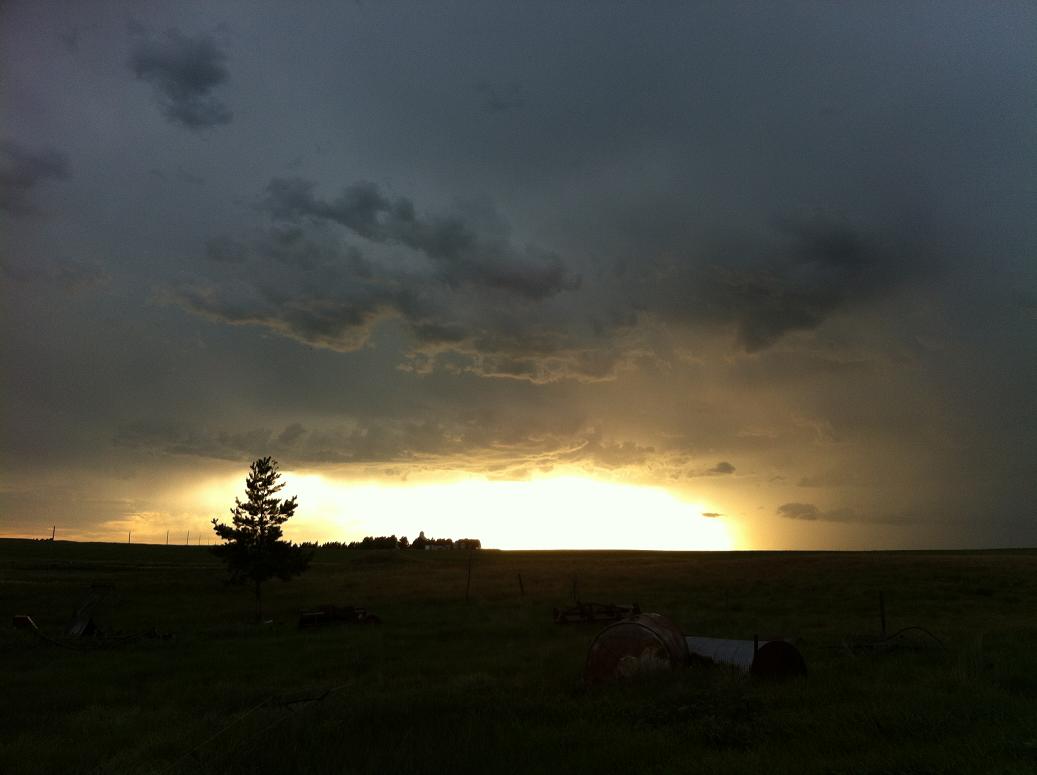
Land of the living Skies :)
Tuesday, July 10, 2012
Chickens part 2: Broilers
The chicken you buy at the store, is the Cornish x or Cornish Giant. Cornish have been selected and bred for fast weight gain. So fast, that it can cripple them. they grow and their legs cannot take it. They are shipped from the hatchery into a barn as day old chicks, and there they remain until they are harvested at 8 weeks. No sunlight, no grass, no fresh air.
Our chickens are raised in open air brooders for the first few weeks. Baby chicks need heat, so they are in brooders with heat lamps. As soon as they start to feather out, and depending on the weather - we move them out at 3-4 weeks.
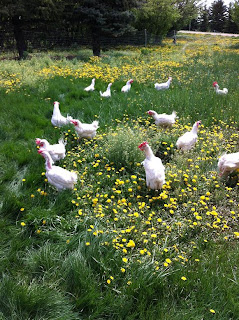
Here are pictures of 4 week old broilers, their first evening out on grass:


Our chickens are raised in open air brooders for the first few weeks. Baby chicks need heat, so they are in brooders with heat lamps. As soon as they start to feather out, and depending on the weather - we move them out at 3-4 weeks.
Here are pictures of 4 week old broilers, their first evening out on grass:


They get to scratch in the dirt, catch bugs, eat grass - things that chickens are meant to do.
Chickens part 1: layers
I haven't posted an update about our pasture poultry yet!
In part 1, I will talk about our laying hens.
 Interested in adding some laying hens to our operation, I started doing some research and decided to order a red sussex cross type layer this Spring. These birds won't be ready to lay eggs until September, so in the meantime, Larry saw an ad for retired battery hens.
These poor gals weren't old, like a year and a bit. They were used to being jammed in a cage most of their life, 4 or 5 of them in a tiny little cage with wire sides, bottoms and tops. Artificial light regulates their daytime so maximize production. They never see daylight or feel grass under their feet, or have enough room to stretch their wings.
We brought them home in April and set them in a temporary old wooden bin so they could acclimatize before turning them out on grass. Their nails were long, their combs pale. They LOVED the bit of sunlight that came in through the wire mesh doors, and the shavings we put down for them to scratch in, and that there was room to run around and stretch their wings! Quite a few died the first week, they didn't know what to make of their freedom and piled into corners at night.
Enjoying some sunlight:
 What they looked like straight from the cages - and believe me, those are 2 of the better looking ones...!


In part 1, I will talk about our laying hens.

These poor gals weren't old, like a year and a bit. They were used to being jammed in a cage most of their life, 4 or 5 of them in a tiny little cage with wire sides, bottoms and tops. Artificial light regulates their daytime so maximize production. They never see daylight or feel grass under their feet, or have enough room to stretch their wings.
We brought them home in April and set them in a temporary old wooden bin so they could acclimatize before turning them out on grass. Their nails were long, their combs pale. They LOVED the bit of sunlight that came in through the wire mesh doors, and the shavings we put down for them to scratch in, and that there was room to run around and stretch their wings! Quite a few died the first week, they didn't know what to make of their freedom and piled into corners at night.
Enjoying some sunlight:


An egg comparison with my own layers, and the Leghorns before they started eating grass:
Pastured egg on left, 'cage' egg on right:


Chicken manure is exellent fertilizer - this was taken in early Spring:

Can you tell the strip where the portable coop was? The green strip in the middle of the photo
Finally it warmed up enough that we could put the hens outside. This was their first day out:

I am happy to report that they adjusted well, enjoy eating grass and chasing bugs and taking dust baths. Their combs look redder, their toenails have worn down from running around, their legs are darker color, and so are their eggs!
Remember, everytime you buy something, you vote - with your money. You are saying, I endorse this product by paying for it. Don't pay for battery hen eggs. Buy free run or better yet, pastured eggs from a farmer that you know and trust.
Saturday, June 23, 2012
Grazing rotations
By dividing your pasture into smaller pastures and rotating through them, you can improve the quality and quantity of grazing available, if done right.

Before the age of Man and Agriculture and fences, wild animals roamed. The herds stayed in tight groups because of potential predators, and they were always on the move, looking for fresh grass. By mimicking nature and putting our animals in a tight group and moving them, we provide several benefits:
1. The grass has time to recover. Animals love fresh re-growth. They will eat the fresh stuff before the stale stuff. Right now our days are long, and grass can grow just about half inch a day, sometimes more. By moving our animals regularly, we avoid grazing the same plant again, while it is recovering from the first graze.
2. We avoid potential parasite problems - especially with the sheep and goats. For parasites to survive they need to hatch out on grass and be consumed by the host species. By keeping our animals moving, we leave the parasites behind, reducing infestation.
3. by grazing a tight herd, whatever doesn't get eaten, gets trampled into the ground. The trampled grass decomposes and feeds the microbes in the soil, providing organic matter for healthier soil. Healthy soil can grow more grass. The trampled stuff also acts like a mulch, keeping moisture in.
4. moving to fresh ground is instinctual, and the animals love it.
5. Its fun! :)
There are more in-depth benefits, but basically we want our pasture to be fully recovered before it is grazed again.
I use Gallagher Smartfence system to divide pastures. Right now I am grazing an area that lacks a permanent perimeter fence. The Smartfence is electrified, and once the animals learn to respect it, it works really well.


Before the age of Man and Agriculture and fences, wild animals roamed. The herds stayed in tight groups because of potential predators, and they were always on the move, looking for fresh grass. By mimicking nature and putting our animals in a tight group and moving them, we provide several benefits:
1. The grass has time to recover. Animals love fresh re-growth. They will eat the fresh stuff before the stale stuff. Right now our days are long, and grass can grow just about half inch a day, sometimes more. By moving our animals regularly, we avoid grazing the same plant again, while it is recovering from the first graze.
2. We avoid potential parasite problems - especially with the sheep and goats. For parasites to survive they need to hatch out on grass and be consumed by the host species. By keeping our animals moving, we leave the parasites behind, reducing infestation.
3. by grazing a tight herd, whatever doesn't get eaten, gets trampled into the ground. The trampled grass decomposes and feeds the microbes in the soil, providing organic matter for healthier soil. Healthy soil can grow more grass. The trampled stuff also acts like a mulch, keeping moisture in.
4. moving to fresh ground is instinctual, and the animals love it.
5. Its fun! :)
There are more in-depth benefits, but basically we want our pasture to be fully recovered before it is grazed again.
I use Gallagher Smartfence system to divide pastures. Right now I am grazing an area that lacks a permanent perimeter fence. The Smartfence is electrified, and once the animals learn to respect it, it works really well.

Can you tell where the electric fence was?
Because this area hasn't been grazed in many years, I used a really small paddock and let the animals take most of the grass (not leaving much litter) to stimulate the grass to grow. Although it looks bare, it was only grazed for a day, so no overgrazing. It is also now littered with goat and horse droppings and urine, which is excellent fertilizer.

Another example, grass was grazed for a day on the right.

This is a picture of a paddock that was grazed and is recovering.
You can still see the line down the middle where the fence was.

animals enjoying fresh grass
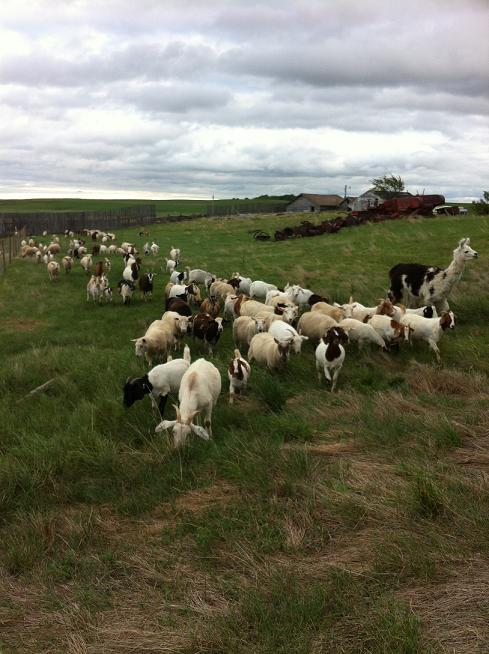
Coming out through an alley to fresh grass.

The Smartfence. There is cropland to the left of the fence, and the goats are cleaning up a stony hill where I want to put up a perimeter fence. It's easier to fence if the grass is short and you can see potential obstacles!

A peaceful early evening graze.
Cattle day

A couple days back I spent the afternoon helping Larry at his branding.
Branding is a way to identify cattle, as they may lose their ear tags but a brand is basically forever. Some countries ban branding, but in Canada it is still very much part of production, with brand inspectors frequenting auction barns to double check that the cows/calves being sold, really belong to that producer.
So there are many different ways to brand, depending on how much help you have. A tip-table is suitable if you have just 2 people, or just a few calves. A calf gets chased down an alley, into the headgate that is mounted on a tip-table. The calf is then tipped onto its side where it is now at table height and easy for people to put eartags in, vaccinate, castrate if it is a bull calf, and brand.
The next way would be, if the calves are small enough, to sort them off from their moms in the corral, and then wrestle them to the ground. You need a few more helpers for this: one person grabs a back leg, the other person grabs the flank and flips the calf. The 2 wrestlers then sit on the ground - one at the hind end holding the back leg, one on the neck/shoulder holding a front leg off the ground. A third person then is needed to vaccinate, tag and brand - or if you have more people, one to brand, one to vaccinate and one to tag. This can be tiring and handlers come away a little bit bruised, with the occasional sprain or broken bone from being kicked by calves.
But we were lucky enough to have skilled ropers and lots of help, so the traditional roping the calves branding is what we had.
I helped with the roundup to get the cattle into the branding pen. We had 7 riders, and the cows are used to being moved, as we rotational graze them. Only problem was, the cows had been going North in their rotation, so that's where they expected to go. We had to turn them south and they were a bit confused by it, but ready to move. The roundup was fast paced and my horse Macy loved it!
We got the cows and calves in, and then got set up:
Propane burners set with branding irons to heat up.
Vaccinations drawn into syringes, ready to administer. Tags got numbered and tag pliers loaded.
squirt bottles filled with antiseptic for castration.
Coolers set out on the tailgate with water and drinks for the crew.
We used a couple of 'snares' to catch the calf:
The roper would go into the herd, and rope the back legs of a calf and drag it towards our staging area. One person would be ready with the snare, which is a Y shaped yoke that would fit behind the calf's ears and line up behind his jaw bone. The snare is attached to an old inner tube (for stretch) that is attached to a stake in the ground. As soon as the calf is in reach, the snare is placed over the head and the roper drags until the rope is tight and the calf immobilized. We had a big crew so after the calf is secure, it went as follows:
One person would be castrating if it was a male. One person on the branding irons, one person vaccinating, 2 people on tags - the personal tag and the government radio ID tag. We had 2 ropers going with 2 snares and things were busy for just under 2 hours to do about 80 calves.

calf being dragged, Doug (red shirt) ready with the snare

Branding irons in the foreground

Cow watching calf being dragged

A perfect day for a branding

my horse Macy watching the show after roundup
Subscribe to:
Posts (Atom)