Showing posts with label life. Show all posts

Sunday, April 7, 2013

Journey to self sufficiency part 1

I'm passionate about self sufficiency and sustainability and being a good steward of the land. My little urban homestead is a work in progress, self sufficiency is a journey and it is certainly not completed in one day!

This list is for my urban homestead. I have a somewhat different view for the little farm where the sheep, goats, horses and other chickens are. More on that in a different post!


The yard September 2009


Early 2010 after a big rain. I had just had some landscaping done and the manure worked into the ground with a tiller. Probably end May?


2010 late May. Still having landscaping issues.


2010 July. The weeds grew prolifically in the new manure enriched soil! 


My square foot garden in 2011. Chicken coop in background


Garden beds changed in 2012 to save space and produce more.


Lawn with micro-clover in (nitrogen fixing) and garden in background, 2012.
The lawn looks bigger than it is. The yard was landscaped in 2009, and again in 2010 and 2011 to fix drainage issues. I also imported several truckloads of rotted manure and spread it in the yard... with a shovel and a rake. :) The ground was bare during landscaping, and this lawn was seeded April 2012, and the picture is early August 2012. Amazing transformation.


A book that inspired me greatly, I still read from it regularly. 
John Seymour wrote about rotational grazing and environmental factors long before others.
The first edition of this book was published in 1976. 


Things I do already:

  • I'm working on creating a permaculture yard with indigenous plant species.
  • A large raised bed vegetable garden with closely spaced plants( think square inch!) and poly culture plantings: planting basil in the shade of tomatoes or radishes with carrots.
  • The chicken coop is in the fruit orchard. The girls provide me with eggs and manure for the garden. They get rotated to fresh grass and get spoils from the garden.
  • I recycle everything I can.
  • I compost everything I can.


Things I would like to do:

  • When my current washing machine quits, I will replace it with an energy free model.
  • When my current dryer quits, I will not buy another one. A clothesline will do.
  • If my kitchen appliances quit, I will replace them with energy free models where possible - hand crank blender, etc.
  • I would like a wood stove for saving on energy bill - in fact I would like a Rocket Stove, which is more fuel efficient than a woodstove. But that might void fire insurance on my house....


Waste:

  • Recycle everything possible.
  • Compost everything possible
  • Re-purpose where possible: re-use egg cartons, re-use tin cans for starting seeds, buy wisely. Buy in bulk to minimize waste and packaging.


Water:

  • I plan to convert my toilet to a composting toilet and use the septic tank for grey water catchment only. That water can be used in the garden. I have a dirt basement so it should be fairly easy. Envirolet Composting has an extensive list of different styles, but I will have to save up some money for that as they are fairly pricey. 
  • Have a rain barrel to catch runoff from the eaves. Maybe even one for next to the chicken coop!
  • One side of my house eaves drain into the well in the front yard. 


Energy:

  • Improve home insulation and ensure doors and windows seal. Use passive heating/cooling by opening curtains on sunny winter morning, closing them to block out heat in summer.
  • I would like to install solar panels and a solar water heater. But good solar panels are still pricey. The provincial government in Ontario has some great programs for solar and wind, but here in Saskatchewan I will have to wait and see what programs they offer in the future.
  • Use space heaters to just warm the rooms you use most, when you use them.
  • When my current washing machine quits, I will replace it with an energy free model.
  • When my current dryer quits, I will not buy another one. A clothesline will do.
  • If my kitchen appliances quit, I will replace them with energy free models where possible - hand crank blender, etc.
  • I would like a wood stove for saving on energy bill - in fact I would like a Rocket Stove, which is more fuel efficient than a woodstove. But that might void fire insurance on my house....

Environment:

  • As many native plant species as possible.
  • Nesting for native bird life.
  • Shelter and food for beneficial insects and birds


Friday, March 15, 2013

The Future of Farming

I often wander what farming would look like if it weren't for fossil fuels.
Grain bins

The most fuel intensive business is farming grains/legumes/oilseed crops like wheat, barley, rye, oats, field peas, lentils, chickpeas, canola, sunflower, corn, soybean.... that sort of thing.
With the advances (really?) of modern (umm) farming, farms are getting bigger and bigger, and to manage more acres, equipment is getting bigger and bigger.
A modern tractor with seeding unit


Most people are so far removed from farming, that the modern farming process is not familiar to all, so let us walk through it, starting in early Spring.
The farmer needs seed and fertilizer. Maybe he has seed left over from last year (if he is allowed to use his own seed - certain seeds like Monsanto owned Canola, Corn, etc can only be bought, NOT stored from last year and re-used.)
So the seed he has needs to be cleaned of weed seeds - a  seed cleaning machine is used for this. An auger is used to move grain from grain bin to cleaner, and from cleaner the weed seeds and smaller cracked seeds go one way (maybe into a grain truck) and the cleaned seeds go another way - into another bin or grain truck.

If the farmer doesn't have seed, he needs to buy it and transport it to his farm. Also fertilizer. Lots of fertilizer is transported in semi trailers to the farms.

Soon after Spring runoff, maybe the farmer will need to work some of his land before seeding. This involves using a tractor and heavy harrows or discs to 'tidy up' after runoff. Maybe he needs to work in some chemical to catch early grassy weeds - again using heavy equipment.

Then comes seeding with heavy tractors and seeding equipment. Grain trucks are used to load the grain carts that go behind the tractor for seeding. Fertilizer is moved to the field this way too. Now the farmer can seed.
 Certain crops (like peas) need to be rolled so a land roller is used, again with a heavy tractor.
a small roller, I couldn't find an image of a bigger one.


Next the crop is sprayed, with tractor and sprayer.
modern sprayer unit


Maybe it gets sprayed a second time before harvest.
A combine harvesting, and filling a grain trailer pulled by a tractor


older style grain truck.

Now it is harvest time! Depending on the crop, this gets done differently:
Lots of crops get 'swathed' which means cut down in rows to dry before harvest.
Swather

After it has dried sufficiently, the combine can come and pick up the 'swaths' and separate the seed from the plant. The combine needs to be emptied, into a waiting grain truck or semi. The truck or semi unit then drives the grain to the grain bins where it gets unloaded using an auger.
The grains get tested for moisture and if it is too moist, aeration fans are plugged into the bins to dry the seed to stop it from spoiling in the bins.
Then, once the farmer sells his grain, it gets hauled out with a semi to a terminal someplace - normally on a railway where rail cars are filled with the grain.

As you can see, that is a lot of steps and a lot of heavy equipment use!
That wheat is nowhere near being made into bread or the canola into oil......

It is estimated that for every calorie of food produced, 10 calories are used up in energy.... seems.... not really sustainable, does it?
two horsepower unit.... nowadays there are 600 horsepower units.....


Conventional livestock is raised on grain.
Chickens, eggs, pigs cannot be raised commercially without grain.
Should we lose fossil fuels, our diet would change considerably!
Eggs, chicken, bacon, bread.... would be a rare treat indeed.
Conventional dairy barns cannot function without grain. Milk (and its by-products like cheese, etc) would sky-rocket in price as production drops without added grain.

How would we deal with this?
I think farms would have to revert back to smaller farms, more producers farming.
Vegetable and fruit cultivation, and ruminants like cattle, sheep and goats rotating over pastures. Pigs can be raised outside too and fattened on root vegetables and the like.

Animals require fodder in the winter months, and making hay means using tractors and swathers and balers..... in the olden days, farmers used to cut hay and grain with sickles and then 'stook' the hay and grains. In fact, in a lot of third world countries this is still done. But one needs to understand how much faster the mighty machine is! There would be severe limitations as to how much we could accomplish, without machines. I would not be able to make hay for my 200 animals, oh no. I might be able to make hay for 20. The same for other producers. We are completely hooked on fossil fuels, as much as we hate to admit it.

But it gives some food for thought! How would we feed the world, if not for oil?


Friday, February 15, 2013

So... what is it you Do all day? A day in the life of me

So what do we DO all day? In Winter?

Well, it depends largely upon the day, the weather, but mostly there are basic chores that need doing every day. How long it takes to do them, depends on the weather, too! There might be snow to move to get at the hay bales and to get through gates. The snow might be blowing making visibility poor, or if its really cold the tractors might need some begging and pleading to start.... No two days are alike!
My day usually begins with a cup of coffee and a fruit and Kefir smoothie (Kefir is a fermented milk drink with lots of probiotics).
I like to wait until sunup to start chores - easier to get around that way.
So I fill a few 4 liter milk jugs with water - one for the hens in the back yard, and about 4 depending on the day, for my needy/sick/elderly  goats I keep separate in the barn.
We suit up to go outside, the number of layers depend on the temperature and wind chill expectancy but my pink coveralls and Muck boots make up part of the clothing every day.

First stop is the chicken coop. I give them fresh water (they have a heated bowl that keeps their water from freezing) and top up their layer ration as needed, open their little pop door and throw a handful of grains outside for them. Normally they all burst out the door! Only when its really windy or snowy do they stay indoors.
The hens have a bit of straw to scratch in, they love it and keeps their toes off the snow :)

Next stop the goats and sheep. I drive the 2km accompanied by my 3 dogs - the Jack Russel called Dude, the Malinois called Spice and the Heeler/Collie cross called Reno.
Normally the sheep are outside, but the goats are still in the barn. Remus, the guard dog will run up to greet us. I feed him and use Spice to kick the couch potato goats out the barn. I find that if I let them have access to the barn 24/7 they tend to spend a lot of time lounging around, so kicking them out when the weather is decent (in my opinion, anything warmer than -10 daytime and no wind...) makes them eat more... and distribute their manure out on the land where it belongs, not in the barn where it needs hauling out by bobcat come spring.
Moving them out the barn gives me opportunity to scan for any sick/injured animals. All look fine, so I head off to the other barn where the needy goats are, towing a toboggan with my milk jugs filled with water.
I water them, give grain and hay and treat whatever needs treating. The barn cat gets fed, and we are basically done here for the morning routine. We roll out hay every 4 days for the goats, so if this was a feeding day, I would use Spice to round up the sheep and bring them into the corral. Both dog and sheep are used to the routine and more often than not, the sheep are in the corral before Spice and I are through the gate... much to her disappointment!


Then we would move in 4 big round bales of hay, cut the strings and roll out the hay with the tractor. When the gate is shut, we open the corral and the animals happily run to the fresh hay.
Rolled out hay. I took this picture in December before we had a lot of snow.

Now on to Larry's farm. Most days in winter he is out trucking for off farm income, so I go down there with the dogs to feed the cows. The cows need feed every 2 days, or every day depending.
So here I start the tractor to let it warm up and use Spice and Reno to move the cows from one pen to the next pen. I put out hay for them with the tractor, cut the strings, and open the gate. The cows come back for feed and I can check them over for any signs of illness. I check the water bowls to make sure they are open, then feed the calves in the next pen. Back in the yard I check the deep freezers to ensure they are working, we have a lot of beef/chicken/turkey frozen at any one time.
My helper Dude on good days, in the tractor

Happy calves on a nice day

Spice the archaeologist showing me her prize.... a dead calf skull and neck from the bury pit. 

A not-so-nice day driving to the farm...

Windy and snowy and cold! 

cow butts, heads buried in hay I put out

Dude on the not-so-nice days, stays in the truck

Cows sheltering at the windbreaks

By this time its normally lunch time so I head back to my house. After lunch I do things in and around the house - cleaning, laundry, or other projects like accounting and financial planning. The office stuff gets neglected during the busy summer months, so there is a lot of catching up to do, filing papers, planning the new years budget, planning grazing and when to market animals, what the breakeven price is, that sort of thing. Also reading - I might spend some time reading articles on animal health, improving facilities, new vaccines, new fencing products, etc.
Then there are website updates and correspondence to keep up with. If we needed to run into town for supplies, now is the time to do it. Closest groceries: 38km one way. Closest city: 100km one way.
An hour or so before sundown I head out to go and give the sheep and goats a bit of grain - my hay tested slightly low on energy and protein so the animals get a little bit of supplemental grain to maintain their body condition as they are all bred now and due to kid/lamb come May 1. I fill 10x 20liter pails with grain, put it in my truck and use Spice again to move the sheep and goats into the corral, so that I can pour out the grain in troughs in the pasture. Then there is a mad dash as all the animals try to fit through the gate at the same time to get at the treat :)
A snowy evening - can you spot the guardian dog in this picture? I just pulled up for evening chores when I took this picture quick before he moved

There he is! 

STREEEETCHHHHH - bear in mind, he picked that spot for himself. He can go into the barn with the sheep and the goats, but he was comfortable on the straw bale stack. 

Delays, delays.... snow blew in again to my 2nd barn where the needy critters are. 

The top wire of the mesh sticking out above a snow drift. the wire that is just below my knee, should be waist high..... Remus runs over the fences, thank goodness the sheep, goats and horses haven't ventured out yet.....! 


I feed the guard dog Remus, check on my needy animals again and treat as needed. If its a nice evening I would take the dogs for a walk.
Remus and Spice playing

A corner where 3 pastures meet... under 4 ft of snow

my well is completely covered now

The snow is deep and I have to stay on top of the hard ridges or risk breaking through to knee deep and in some places hip deep snow. We admire the sunset, listen to coyotes howling in the distance and head back home.
Remus on a windy evening walk

At home I go collect eggs from the coop and lock the hens in for the night to avoid predators turning them into a midnight lunch.
The hens waiting for their evening snack. See their fence covered in snow in the foreground? The hens only venture as far as the compacted path I made, they stay out of the deep snow. 


A peaceful evening
 

Now it is time for my supper and a chance to put my feet up!

Saturday, January 12, 2013

Blizzard Part 2: digging out

The wind blew relentlessly through the night.
The next morning even before it was light, I knew there was a LOT of snow.
View from my livingroom window early morning. No main street visible... can just see the rink on the far side of the street

Going out to water chickens, snow over my knees

Dude looking hopeful that we can get in the truck

Garden shed

Main Street when it was still blowing

Main Street was impassable. I was stuck until someone came to blade me out.
I spent the morning doing a few things around home.
Walked out to the hens and gave them fresh water and some scratch grains. The snow was over my knees on the way to the coop. My yard is pretty sheltered with a lot of trees so normally I do not get much for snow drifts.
I spent a vigorous 20 minutes digging out my truck, and then used the roof rake to rake some snow off my house roof - being an older house, it needs insulation in the attic and the heat escapes there, so ice dams could form on the roof if the snow is not cleared off. Insulating the attic is #459 on my to-do list for this year. :)

The wind was still blowing, I walked up Main Street a ways where a tractor had plowed a single lane - visibility was still poor and I had to wait for the street to be cleared because there was 20 feet of 3 foot deep snow between my truck and the lane.
Finally at 1:30 the wind had died down enough and the tractors started clearing the street (living in a very small town, we just have a neighboring farmer come and clear snow from the streets)
Main Street

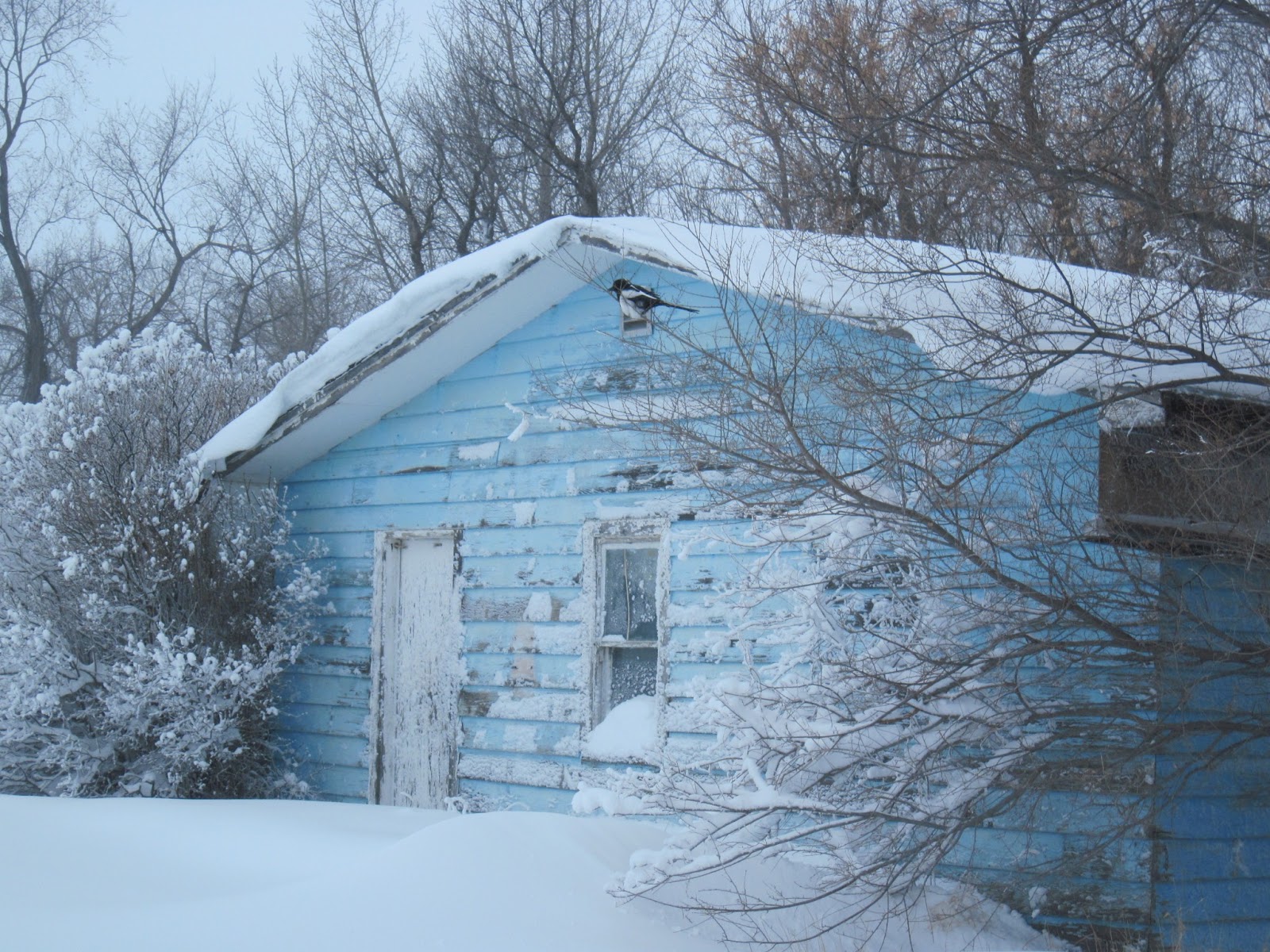
Abandoned house on Railway Avenue, magpie in the tree

Main Street after I got bladed out - still not cleaned up to go North.

The bit of pavement out to my goats had drifts on it, but with 4x4 I could get through. The biggest drifts, however were at the goat farm. Oh my goodness!

One massive one blocked my access to the old shop - that's where I have some good square bales stashed in the back, and my more needy goats (the sick or old or injured) stay in the front. the drift was well over 6 feet high, and over 10 feet wide. Nothing to do but start clearing a track so I could open the little gate and get at some square bales to toboggan for the goats in the barn.


The massive drift in front of the shop

I crawled up part of it to peer in


There I can see the goats and the top of the 4ft high little gate

I knew that under the snow was a 4 ft high, 8 ft long gate perpendicular to the shop and if I could find it, I could follow it to tunnel into the shop. The photo below you can see a slight line that is the top of the 4ft high gate. A goat is looking hopeful that I would reach them


Some serious elbow grease later! I can see the gate! 

From inside the shop looking out.

That task done, I checked on the barn. All the animals had come up to the barn, and the track to the round bales was blown in. I trail blazed for them (no mean feat) and the horses followed, making an easier trail for the sheep who streamed out, grateful.


Snow drifts in the corral

Spice standing on top of a 4ft high drift

Putting the hay bales on edge, kinda makes its own little windbreak. You can see the snow piled on the North side of the bale. The sheep have been bedding in the hay that they are not eating. 

Happy sheep this morning (Saturday)

At Larry's farm - laneway


Sheep and drifts

Closeup of wind sculpted snow

Drifts in the corral.


I tobogganed some square bales to the barn for some goats that were still reluctant to leave their shelter for food. Lucky everyone had survived the storm. Goats are finicky and might just get depressed and die if a storm lasts too long! Good thing I had forked in hay the day before, it was all gone. 
The force of Nature is incredible. We will be dealing with the aftermath of this for a while. I had a friendly neighbor help me clear some snow at the goats, but Larry and I will have to dig out goats and clear a track in the pasture over the next couple days to be able to get in to feed. Monday is supposed to be +2 which should settle the snow so it quits blowing. 
But yes, Mother Nature is a force to be reckoned with. :)