Showing posts with label ethical. Show all posts

Tuesday, July 10, 2012

Chickens part 1: layers

I haven't posted an update about our pasture poultry yet!
In part 1, I will talk about our laying hens.

Interested in adding some laying hens to our operation, I started doing some research and decided to order a red sussex cross type layer this Spring. These birds won't be ready to lay eggs until September, so in the meantime, Larry saw an ad for retired battery hens.
These poor gals weren't old, like a year and a bit. They were used to being jammed in a cage most of their life, 4 or 5 of them in a tiny little cage with wire sides, bottoms and tops. Artificial light regulates their daytime so maximize production. They never see daylight or feel grass under their feet, or have enough room to stretch their wings.

We brought them home in April and set them in a temporary old wooden bin so they could acclimatize before turning them out on grass. Their nails were long, their combs pale. They LOVED the bit of sunlight that came in through the wire mesh doors, and the shavings we put down for them to scratch in, and that there was room to run around and stretch their wings! Quite a few died the first week, they didn't know what to make of their freedom and piled into corners at night.
Enjoying some sunlight:
What they looked like straight from the cages - and believe me, those are 2 of the better looking ones...!


An egg comparison with my own layers, and the Leghorns before they started eating grass:
Pastured egg on left, 'cage' egg on right:


Chicken manure is exellent fertilizer - this was taken in early Spring: 

Can you tell the strip where the portable coop was? The green strip in the middle of the photo 

Finally it warmed up enough that we could put the hens outside. This was their first day out:

I am happy to report that they adjusted well, enjoy eating grass and chasing bugs and taking dust baths. Their combs look redder, their toenails have worn down from running around, their legs are darker color, and so are their eggs! 

Remember, everytime you  buy something, you vote - with your money. You are saying, I endorse this product by paying for it. Don't pay for battery hen eggs. Buy free run or better yet, pastured eggs from a farmer that you know and trust. 


Thursday, January 12, 2012

Exciting times!

A New Year, new possibilities!
I love my life! So much to learn, every day. I always knew that I wanted to farm, somehow, somewhere. Now it is becoming a reality. In 2011 I expanded my goat herd to 70. I got 50 sheep. I look forward to this years kidding and lambing season!
A few images from the past year:
A Year of Storms: 
We had some pretty scary looking clouds, rain, wind, hail, and floods.


 Flood water


Chickens
Can you spot the goat in the photo below?
One of my last orphans curled up with the chickens one chilly evening
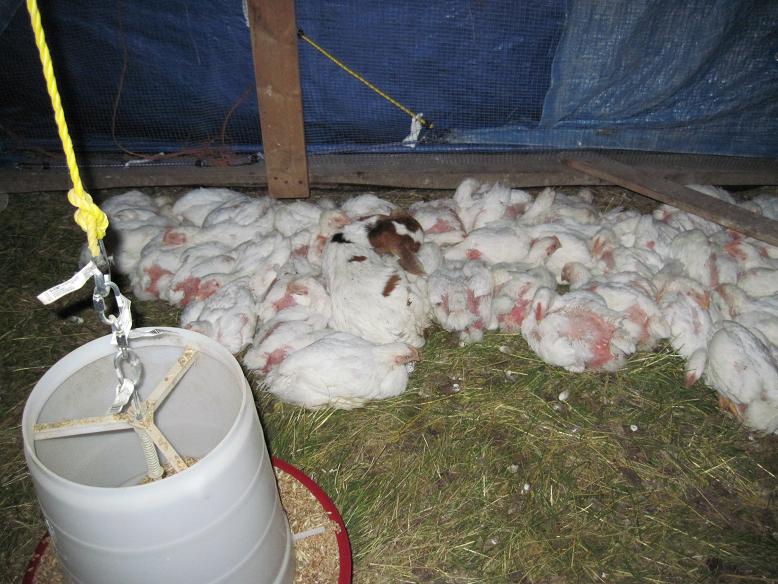
 Chickens enjoying space, sunshine, shade, grass. 
We try to raise our animals as ethically, naturally and sustainably as possible.


Custom cows
my boyfriend grazed some 220 custom cattle this summer


Garden
 My square foot garden in my back yard, with my chicken coop visible


 Sheep and goats


 Winter Wonder


Saturday, December 10, 2011

The dilemma of buying eggs

I have a small flock of heritage chickens, about 16 hens. Chantecler (the only Canadian breed of chicken) and Buckeye. They are cold-tolerant (no combs to freeze on these chickens) and very friendly. I built them an insulated coop with 2 large South facing windows for lots of natural daylight. Normally they are out from dawn till dusk, foraging. Even in winter I will leave the pop door open on most days, and some of them will venture out (as long as I shovel the snow away from the coop) and sit in the sun or wander around.
Well, these hens give me a glorious abundance of eggs in summer - usually a dozen a day. The yolks are dark yellow, almost orange. We feast on eggs in summer! Omelets, scrambled, fried, boiled. I pickle bottles full that disappear just as fast as I can make them! I sell some and give some away to family.
But Fall arrived and my hens started molting. And stopped laying. One by one, until I was getting an egg a day. Now - nothing. And its Christmas baking season, I need eggs!
So off to the store I venture. Hmmm. The cheapest eggs are $2.81 per dozen. Doesnt say anything about free run or free range. There are some Organic Free Range eggs for $5.89 per dozen, and some Free Run eggs for $5.79.
In principle, buying cage raised eggs for $2.81 a dozen just seems.... wrong. If you have ever been to an egg farm (and I have) and seen 5 hens per cage that is about 2ftx2ft, with wire floor, stacked 5 high in a barn with about 2,000 birds..... no sunlight, no green grass, no dirt to scratch in. No quality of life. These hens are pale, their eggs are pale. They have a conveyer bringing them food 24/7, and a conveyer collecting the eggs that roll out of the slanted floor 24/7. Oh, my heart breaks for them. Sure, they know no different, but is that a good reason to treat them the way we do?

I have full empathy for city dwellers who cannot have a backyard hen or 3, and that want to eat ethically produced, natural food. And all that on a budget. How do you justify buying $5.89 eggs when you can buy $2.81 eggs?

So what did I end up buying? The $5.89 organic free range eggs. I gave my support to what I believe in.

Wednesday, July 20, 2011

Feeding antibiotics to animals

When I got my first turkeys this year, I was dismayed to find that a large feed mill in my province doesn't make antibiotic free starter for turkeys. Even the turkey grower is medicated! So I followed some advice from the American Pastured Poultry Producers Association and fed them non-medicated chicken starter, with some boiled egg crumbled in to provide the extra protein. Turkeys are now 8 weeks old and outside on grass, doing GREAT. Out of 50 I lost 7. Not too bad stats for my first time raising them I think.

So the theory behind feeding medicated feed to animals is because humans place them in stressful situations (beef feedlots are overcrowded and unsanitary, same goes for chicken and turkey and hog barns in conventionally raised animal production) - feed them antibiotics to prevent them from getting sick due to the overcrowding or unsanitary conditions. Treating the SYMPTOM, not the CAUSE. Prevent the overcrowding, and the symptoms will disappear.

We all know that young children are prone to ear infections, sinus infections, tonsillitis and all sorts of other bacterial infections - so why does conventional wisdom not recommend feeding kids medicated food to prevent these illnesses? Because we know that overuse of antibiotics will cause resistant strains of bacteria to develop. Well, erm, will the same thing not happen with animal production and its preventative use of antibiotics?

Hence here at Pilgrim Farms, we try to raise our animals in stress-free environment, with no added antibiotics or hormones. The chickens are raised in brooder houses with ample space, clean litter and clean water and feed dishes. As soon as they are old enough(3-4 weeks depending on weather) they are moved to the pasture pens where they get to enjoy sunlight, dirt to scratch in, grass to nibble on, bugs to chase and all the free choice locally grown grains they can eat. I love watching them lie down and stretch a leg out as if they are enjoying a day suntanning at the beach. And when I move the pens to give them access to fresh grass, its a joy to watch them explore, gobble up some grass, dandelions and alfalfa and chase the occasional bug. I am proud to raise such healthy animals. I strive to provide the best natural and ethical care possible.